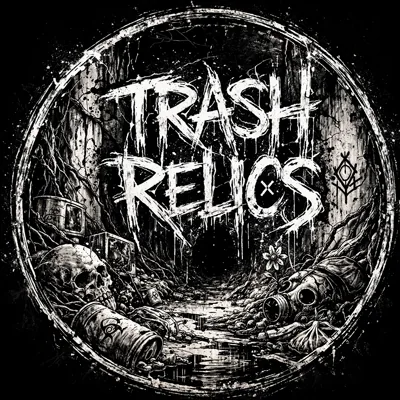
An Archive of What Remains

Trash Relics

A Post-Apocalyptic Environmental Art Archive

5,000 unique relics emerging from the ruins of a forgotten world.


Each piece captures the silent aftermath of human collapse.
Objects abandoned. Environments reclaimed.
Life slowly adapting to what remains.

Rendered in distressed black-and-white ink, every relic becomes a fragment of a larger archive documenting Earth's recovery after humanity.

Uncover a Relic. Restore the Earth

5,000 Relics | Base Rarity System | Environmental Impact | On-Chain Archive

What Trash Relics Is

Trash Relics is a fixed-supply environmental NFT archive documenting a post-human world shaped by ecological collapse and material excess.

Permanent Archive

5,000 unique relics permanently preserved on the blockchain.

Each artifact represents a fragment of a forgotten human civilization.

Environmental Digital Art

Discarded human objects are transformed into preserved relics through distressed black-and-white illustration.

Each piece documents the silent return of nature.

A Closed System

The archive does not expand, reset, or dilute.

Trash Relics exists as a permanent record with a fixed structure and predefined rarity architecture.

The Structural System

Fixed Supply

The collection is permanently capped at 5,000 relics.

No expansion. No dilution.

Environmental Allocation

Rarity influences structural positioning within the archive and affects TRC distribution weighting.

Supply and ownership remain unchanged.

Rarity Architecture

Each relic carries a Base Rarity Score (/14) calculated through a weighted trait architecture permanently indexed on-chain.

TRC Distribution Logic

A permanent 8% environmental allocation is embedded directly into the system architecture.

This structural commitment supports ecological initiatives and environmental organizations, ensuring that the archive contributes to real-world environmental responsibility.

The allocation is fixed within the framework of Trash Relics and remains part of the archive’s long-term environmental mission.

Post-apocalyptic abandoned camera relic artwork from the Trash Relics environmental NFT archive documenting human artifacts after ecological collapse.
Post-apocalyptic digital relic artwork showing an abandoned container in a ruined industrial environment, part of the Trash Relics environmental NFT archive.
Trash Relics emblem representing the environmental NFT archive
Post-apocalyptic bottle relic artwork showing an abandoned artifact reclaimed by nature, part of the Trash Relics environmental NFT archive.
Post-apocalyptic shipwreck relic artwork from the Trash Relics environmental NFT archive documenting remnants of human civilization.

Environmental Impact

Trash Relics integrates real-world environmental impact directly into its core architecture, making ecological responsibility a permanent part of the system.

8% Environmental Allocation

A permanent portion of the system is dedicated to supporting ecological initiatives and environmental organizations.

Structural Commitment

This allocation is built into the archive's architecture.

It is not promotional or temporary.

Each relic preserves more than a fragment of the past.

Long-Term Responsibility

Trash Relics prioritizes long-term ecological responsibility over short-term visibility.

Digital permanence matched with ecological responsibility.

Digital Permanence

The archive documents environmental consequences while contributing to real-world ecological accountability.

The Archive Is Fixed

Trash Relics is a permanent environmental NFT archive of 5,000 relics documenting ecological consequences through structured post-apocalyptic digital art.

No Expansion.

The archive will never grow beyond 5,000 relics.

No Dilution.

Existing relics cannot lose rarity through future releases.

No Structural Revision.

The core architecture remains permanent.

This is not an evolving release cycle.
It is a finite blockchain record.

The World of Trash Relics

The world of Trash Relics imagines a future where human civilization has vanished, leaving behind fragments of material culture scattered across abandoned landscapes.

Objects once considered ordinary; shoes, machines, containers, and forgotten technologies; become relics documenting the consequences of excess and ecological imbalance.

Within this archive, nature slowly reclaims what was once human territory. Forests grow through broken structures, fungi emerge from discarded artifacts, and ecosystems adapt to the remnants of industrial civilization.

Trash Relics does not portray heroes or myths.

It documents the quiet aftermath of human presence on Earth.

Each relic preserved in the archive represents a fragment of that world; a visual record of collapse, adaptation, and ecological memory.

Post-apocalyptic vinyl record relic reclaimed by nature in a ruined city, artwork from the Trash Relics environmental NFT archive.

Follow Trash Relics

Follow Trash Relics for updates on environmental NFT releases, rarity architecture insights, and archive documentation.

Instagram

Twitter/X

Understanding the Trash Relics Archive

Trash Relics is a permanent environmental NFT archive built on blockchain technology, documenting a post-human world shaped by ecological collapse and material excess.

The collection consists of 5,000 unique digital relics, each representing an artifact of a lost civilization.

Each relic is rendered through distressed black-and-white illustration, emphasizing decay, memory, and the transformation of human-made objects over time.

As nature reclaims abandoned environments, the archive captures the silent transition from human dominance to ecological recovery.

The archive serves as both a visual record and a conceptual framework exploring the consequences of industrialization and environmental neglect.

Unlike evolving NFT collections, Trash Relics operates within a fixed structural system. It does not expand or dilute, preserving the integrity and rarity of each relic.

This permanence defines the project’s core philosophy: documenting what remains rather than creating what comes next.

Through this system, Trash Relics connects digital permanence with real-world ecological awareness.